6/20/2012
THE WORM IN THE APPLE By John Cheever
Page 1 (Introduction to Literature)
THE WORM IN THE APPLE By John Cheever
The Crutchmans were so very, very happy and so temperate in all their habits and so pleased with everything that came their way that one was bound to suspect a worm in their rosy apple and that the extraordinary rosiness of the fruit was only meant to conceal the gravity and the depth of the infection. Their house, for instance, on Hill Street with all those big glass windows. Who but someone suffering from a guilt complex would want so much light to pour into their rooms? And all the wall-to-wall carpeting as if an inch of bare floor (there was none) would touch on some deep memory of unrequition and loneliness. And there was a certain necrophilic ardor to their gardering. Why be so intense about digging holes and planting seeds and watching them come up? Why this morbid concern with the earth?
She was a pretty woman with that striking pallor you so often find in maniacs. Larry was a big man who used to garden without a shirt, which may have shown a tendency to infantile exhibitionism.
A Haircut by : I. S. Nakata
Page 1 (Introduction to Literature)
A Haircut by : I. S. Nakata
People have trouble deciding what I am. Indians mistake me for one of their own; in Chinatown they gave me a menu written in Chinese; and once even a Japanese kid asked me if I was Korean. My ancestors are full-blooded Japanese, but I have had to get used to people thinking I’m something else.
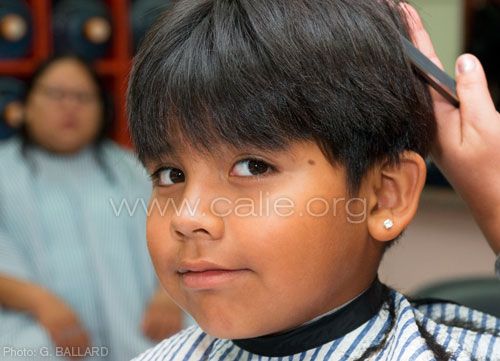
Like that time I went to the barber college on North Clark Street for my cut-rate haircut. It’s a place where student-barbers get on-the-job training, and that’s where I met this guy. He was last in line, and he kept staring at me as I walked in. I just stared back.
6/19/2012
The Spell by Arthur Gordon
Page 1 (Introduction to Literature)
The Spell by Arthur Gordon
Excuse me, sir, I see that you are smoking – could you possibly spare a cigarette? We are not allowed to have them here. A wise rule, no doubt, in the majority of cases. Lunatics should never be trusted with fire.
But believe me, sir, I don’t belong in this place with all these crazy people. Really, I don’t! I’m as sane as anyone, as sane as you are. But there you sit in your parked car, free to come and go as you please. And here am I behind these bars…
A MAN WHO HAD NO EYES by Mackinlay Kantor
Page 1
A beggar was coming down the avenue just as Mr. Parsons emerged from his hotel.
He was a blind beggar, carrying the traditional battered can, and thumping his way before him with the cautious, half-furtive effort of the sightless. He was a shaggy, thick-necked fellow; his coat was greasy about the lapels and pockets, and his hand splayed over the cane’s crook with a futile sort of clinging. He wore a black pouch slung over his shoulder. Apparently he had something to sell.
The air was rich with spring; sun was warm and yellowed on the asphalt. Mr. Parsons,
standing there in front of his hotel and noting the clack-clack approach of the sightless man, felt a sudden and foolish sort of pity for all blind creatures.
And, thought Mr. Parsons, he was very glad to be alive. A few years ago he had been
little more than a skilled laborer; now he was successful, respected, admired…
Insurance… And he had done it alone, unaided, struggling beneath handicaps… And he
was still young. The blue air of spring, fresh from its memories of windy pools and lush shrubbery, could thrill him with eagerness.
He took a step forward just as the tap-tapping blind man passed him by. Quickly the
shabby fellow turned.
"Listen guv’nor. Just a minute of your time."
Mr. Parsons said, "It’s late. I have an appointment. Do you want me to
give you something?"
"I ain’t no beggar, guv’nor. You bet I ain’t. I got a handy little article here" he
fumbled a small article into Mr. Parsons’ hand " that I sell. One buck. Best cigarette
lighter made."
Page 2
Mr. Parsons stood there, somewhat annoyed and embarrassed. He was a handsome figure with his immaculate grey suit and grey hat and malacca stick. Of course, the man with the cigarette lighter could not see him…
"But I don’t smoke," he said.
"Listen. I bet you know plenty people who smoke. Nice little present," wheedled the man. "And, mister, you wouldn’t mind helping a poor guy out?" He clung to Mr. Parsons’
sleeve.
Mr. Parsons sighed and felt in his vest pocket. He brought out two half dollars and
pressed them into the man’s hand. "Certainly I’ll help you out. As you say, I can give it to someone. Maybe the elevator boy would " He hesitated, not wishing to be boorish and inquisitive, even with a blind peddlar. "Have you lost your sight entirely?"
The shabby man pocketed the two half dollars. "Fourteen years, guv’nor." Then he added with an insane sort of pride: "Westbury, sir, I was one of ‘em."
"Westbury," repeated Mr. Parsons. "Ah yes. The chemical explosion . . . the papers
haven’t mentioned it for years. But at the time it was supposed to be one of the greatest disasters in"
"They’ve all forgot about it." The fellow shifted his feet wearily. "I tell you, guv’nor, a
man who was in it don’t forget about it. Last thing I ever saw was C shop going up in one grand smudge, and that damn gas pouring in at all the busted windows."
Mr. Parsons coughed. But the blind peddler was caught up with the train of his one
dramatic reminiscence. And, also, he was thinking that there might be more half dollars in Mr. Parsons’ pocket.
Page 3
"Just think about it, guv’nor. There was a hundred and eight people killed, about
two hundred injured, and over fifty of them lost their eyes. Blind as bats." He groped
forward until his dirty hand rested against Mr. Parsons’ coat. "I tell you sir, there wasn’t nothing worse than that in the war. If I had lost my eyes in the war, okay. I would have been well took care of. But, I was just a worker, working for what was in it. And I got it. You’re damn right I got it, while the capitalists were making their dough! They was insured, don’t worry about that. They "
"Insured," repeated his listener. "Yes, that’s what I sell. "
"You want to know how I lost my eyes?" cried the man. "Well, here it is!" His words fell with the bitter and studied drama of a story often told and told for money. "I was there in C shop, last of all the folks rushin’ out. Out in the air there was a chance, even with buildings exploding right and left. A lot of guys made it safe out the door and got away. And just when I was about there, crawling along between those big vats, a guy behind me grabs my leg. He says, ‘Let me past, you ! Maybe he was nuts. I
dunno. I try to forgive him in my heart, guv’nor. But he was bigger than me. He hauls me back and climbs right over me! Tramples me into the dirt. And he gets out, and I lie there with all that poison gas pouring down on all sides of me, and flame and stuff . . ." He swallowed -- a studied sob—and stood dumbly expectant. He could imagine the next words: Tough luck, my man. Damned tough luck. Now I want to "
That’s the story, guv’nor."
The spring wind shrilled past them, damp and quivering.
Not quite," said Mr. Parsons.
Page 4
The blind peddlar shivered crazily. "Not quite? What do you mean, you ?--"
"The story is true," Mr. Parsons said, "except that it was the other way around."
"Other way around?" He croaked unamiably. "Say, guv’nor---"
"I was in C shop," said Mr. Parsons. "It was the other way around. You were the fellow
who hauled back on me and climbed over me. You were bigger than I was, Markwardt."
The blind man stood for a long time, swallowing hoarsely. He gulped: "Parsons. By
heaven. By heaven! I thought you--" And then he screamed fiendishly: "Yes. Maybe so.
Maybe so. But I’m blind! I’m blind, and you’ve been standing there letting me spout to
you, and laughing at me every minute of it! I’m blind!"
People in the street turned to stare at him.
"You got away but I’m blind! Do you hear? I’m---"
"Well," said Mr. Parsons, don’t make such a row about it, Markwardt…So am I."
3/07/2009
What is Literature
Furthermore, Barnet says that literature is a “short of make- believe” as suggested by its genres : fiction, drama, and poetry. If literature is defined as something ‘creative’ or ‘imaginative’, it is still open arguments. Eagleton argues that It is defined as “ any writing which has the power to move readers’ hearth or to stir his/her emotions”.
Some others attempts to define as “the expression of beautiful thoughts and ideas in beautiful language. This may be not always acceptable. Eagleton states that literature may be better defined according to its particular use of language. He bases his statement upon Jacobson’s idea saying that literature is” a kind of writing which represents an organized violence committed on ordinary speech (and which) transforms and intensifies ordinary language and makes it deviate systematically from everyday speech”.
Anyhow, there is a notion worth considering: Literature is a cultural production which is in a certain society and in certain era regarded as literature. This view rests on facts that literature is not a free object. In specific term literature is defined as a permanent writing which expresses and communicates thought, feeling, and attitudes toward life and the world (William : 1965).
Others definition of literature:
1. Definitions of the word literature tend to be circular. The Concise Oxford Dictionary says it is “writings whose value lies in the beauty of form or emotional effect.” The 19th-century critic Walter Pater referred to “the matter of imaginative or artistic literature” as a “transcript, not of mere fact, but of fact in its infinitely varied forms.”
2. Based on pocket Oxford dictionary literature is writings values as works of art.
3. Literature, according to Garnet in English literature, is the daughter of language. For the study, therefore of a literature is essential to process a clear view of any features of the idiom in which it is conveyed which may contribute to impress it with a peculiar character.
4. Literature is the art that expresses life in words that appeal to our own sense of the beautiful, we have many writers but few artist. In the broadest sense perhaps literature means simply the written records of the race including all its history and sciences, as well as its poem and novels; in the narrower sense of literature is the artistic record of life and most of our writing is excluded from it, just as the mass of our buildings, mere shelters from storm and from cold, are excluded from architecture. A history or a work of science may be and some times is literature. But only as we forget the subject matter and the presentation of facts in the simple of its expression ( Long : 1945 )
5. As one of the arts, literature is said to have esthetic value, the response to literature as an art form is called the esthetic response and the response is to its beauty the esthetic response is some what hard to define but every one is know what it is. It is an experience that can be isolated from other experiences, being different in character from them ( Rohr Berger )
6. Literature is, first of all, a creative work of art, an object that an artist makes. It is not merely an idea a theory, a system of thought, although ideas, theories and system of thought enter into it. ( J William : 1965 )
References :.
Barnet Sylvan, Berman Morton, Burto William. 1963. An introduction to Literature. USA: Little Brawn and Company.
Garnet Richard. English literature an illustrated record. New York : The Macmillan Company
J. George William. 1965. Response to Literature. USA: Mc Hall inc
Long J William. 1945. English Literature its History and its significance for the life of the English speaking world. USA. Gin and Company.
Rohr Berger Mary. An introduction to Literature